
How can Europe turn Payments for Forest Ecosystem Services from promising local initiatives into stable, scalable policy instruments? The LIFE ProForPES project – Promoting Effective Forest Payments for Ecosystem Services Through EU Financial and State Aid Programs – has published a new policy brief outlining concrete recommendations to improve the design, financing, governance and integration of ForestPES into EU policies and funding frameworks.
Co-funded by the European Union through the LIFE Programme, ProForPES was created to collect, synthesise and integrate existing knowledge and practical experience on Payments for Ecosystem Services at national and EU level. Its overall aim has been to identify how PES and PES-like mechanisms can be more effectively embedded in European financial frameworks and translated into workable approaches for forest owners, managers, policymakers and other actors.
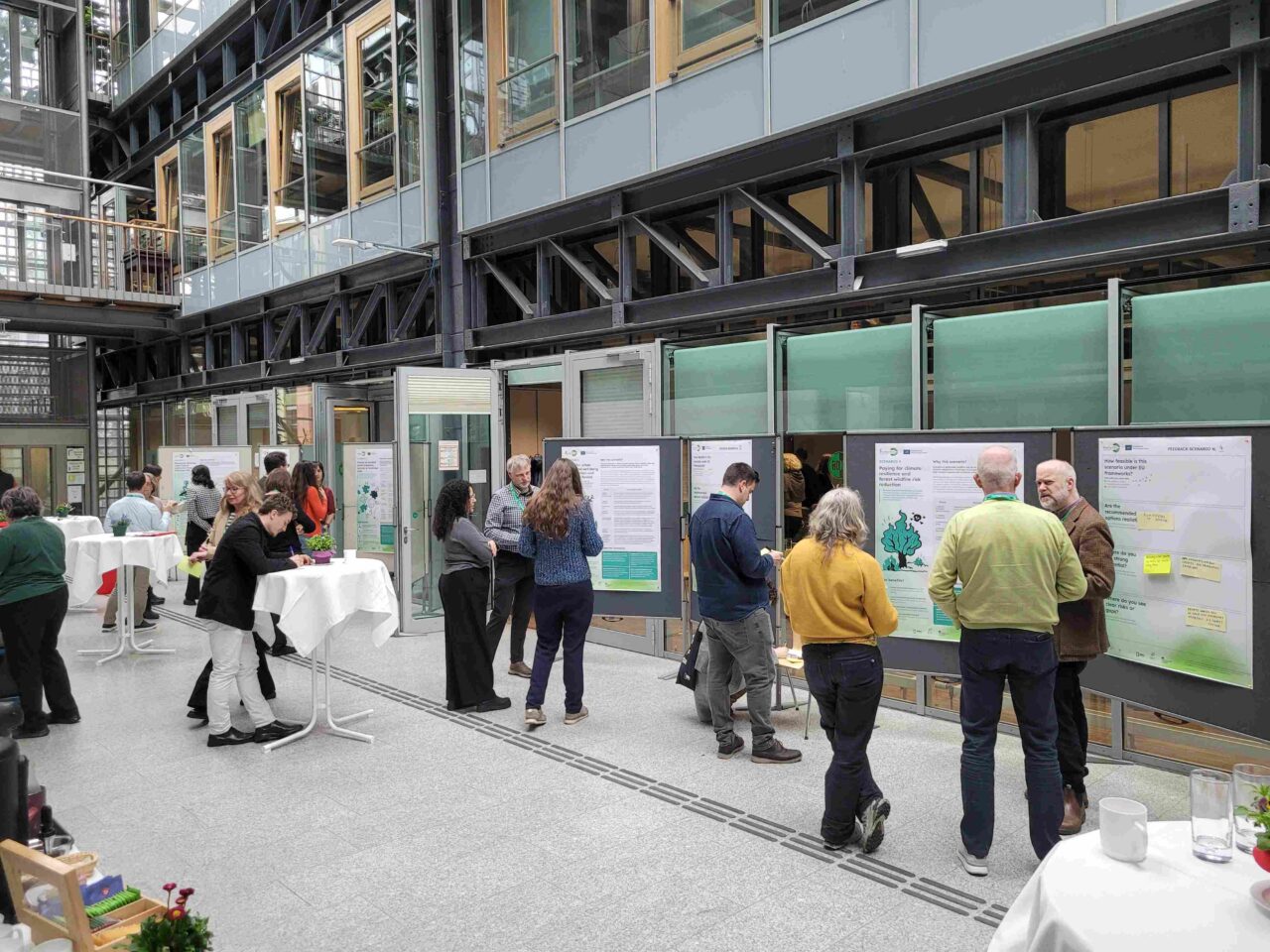
Final stakeholders workshop- March 2026- Vienna- BOKU University
Over the course of the project, LIFE ProForPES analysed more than 100 PES and PES-related mechanisms across Europe, examined their institutional and financial arrangements, reviewed EU policy and financing programmes, assessed implementation barriers and opportunities, and involved experts and stakeholders in developing and testing future approaches.
The work highlighted an important gap: while forests and the ecosystem services they provide are increasingly recognised in European policy, this recognition is still not matched by the same level of operationalisation and financial commitment to ForestPES schemes.
This need to turn existing knowledge into practical implementation was also emphasised during the project’s stakeholder discussions.
“We already have a substantial body of knowledge on forest ecosystem services and Payments for Ecosystem Services. The next step is to turn this knowledge into implementation. To make an impact, scientific concepts need to be translated into approaches that are feasible, understandable and accessible to the actors who will put them into practice.”
— Georg Rappold, Head of Department for Wood Policy, Bioeconomy and Innovation, Austrian Federal Ministry of Agriculture, Forestry, Regions and Water Management (BML)
From research to concrete policy recommendations
Building on this evidence, the new policy brief translates the project’s findings into practical recommendations for policymakers, funding authorities and developers of ForestPES schemes.
Two priorities stand out: developing a dedicated European ForestPES framework supported by a wider funding mix, and strengthening the forestry focus within the Common Agricultural Policy (CAP). The proposed European framework would complement existing mechanisms and provide greater visibility and coherence for ForestPES, while the CAP could offer more accessible and better-adapted opportunities for forest managers.
This was also reflected in the contribution of Sven Wunder, PES leading expert at the European Forest Institute, who highlighted the potential role of existing agricultural funding in supporting environmental services and forestry:
“A key question is to what extent existing farm subsidies could be repurposed towards payments for environmental services. We already have substantial funding going into agri-environmental schemes; the question is whether some of that funding could also be directed towards forestry.”
— Sven Wunder, Principal Scientist, European Forest Institute
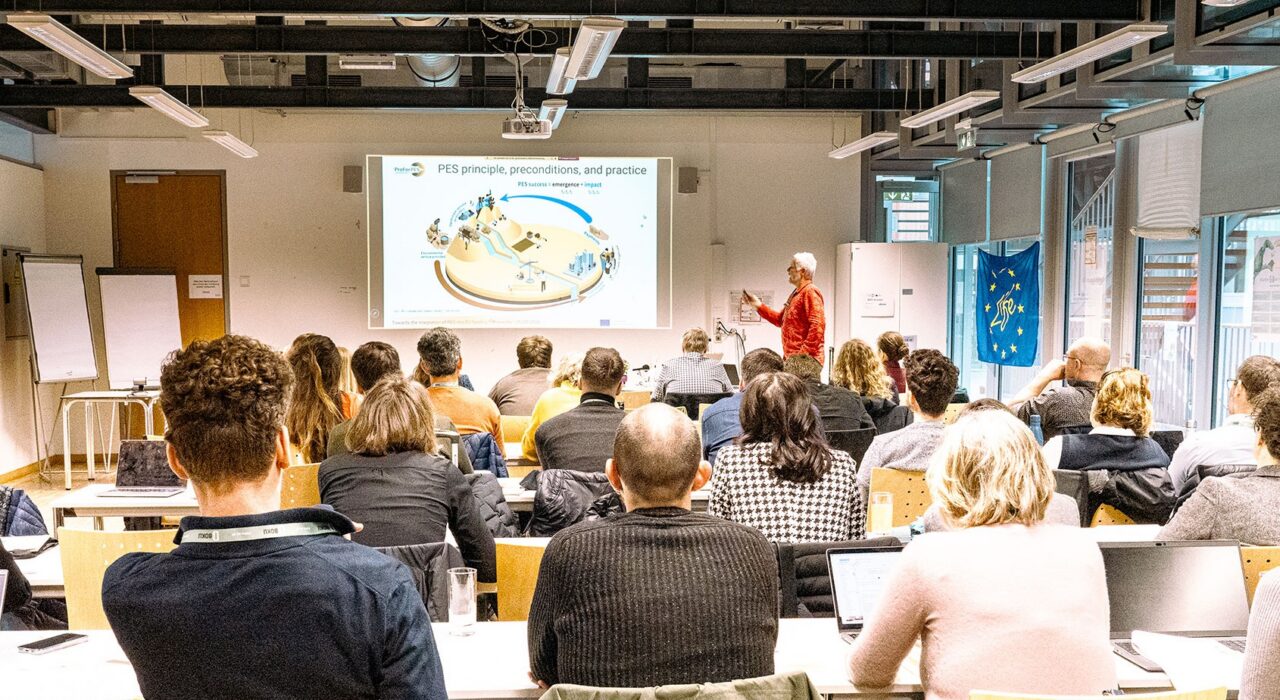
Stakeholder and expert engagement played an important role in translating LIFE ProForPES research into recommendations for future European funding programmes.
Beyond these two priorities, the policy brief recommends greater legal and financial stability, blended public and private finance, hybrid action- and result-based payments, proportionate monitoring systems, improved communication and awareness, stronger governance and intermediary roles, and closer integration with environmental and land-use policies.
A further proposal is the creation of a European ForestPES Gateway: a multilingual and user-friendly platform that could provide templates for PES schemes and contracts, indicator and monitoring frameworks, training and guidance materials, case examples and communication resources.
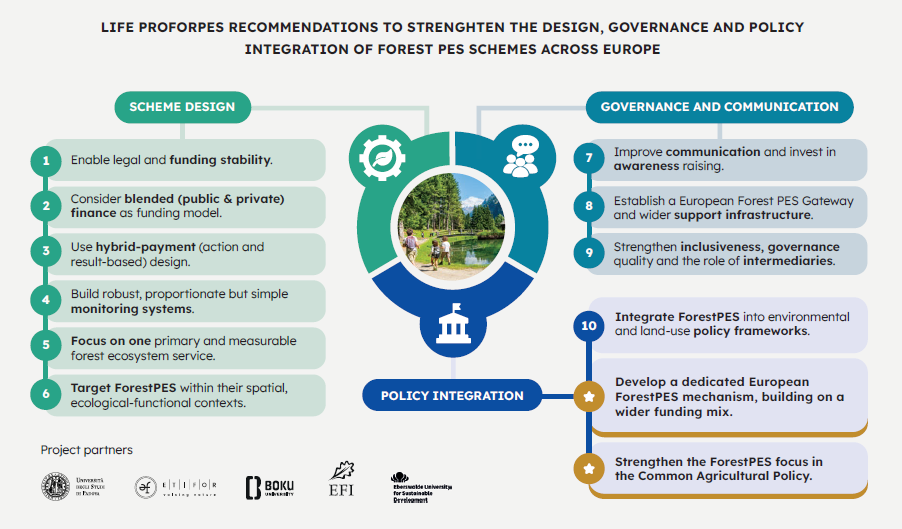
The LIFE ProForPES policy brief brings together recommendations on scheme design, governance and communication, and policy integration.
With the publication of the policy brief and the accompanying Guidelines and recommendations on incorporating PES in EU-supported financial programmes, LIFE ProForPES brings together its research into a practical roadmap for moving from fragmented initiatives towards more stable, scalable and operational ForestPES mechanisms.
The project’s final recommendations aim not only to improve how ForestPES schemes are designed, but also to support their wider integration into future European funding programmes and policy frameworks.
Explore the LIFE ProForPES policy brief here in five languages and the full recommendations report/Deliverable 4.2 here to learn how ForestPES can be better integrated into future European policies and financial programmes.